This is not another think piece, at least not yet, about AI, the future of publishing, or the philosophical, legal, and practical questions raised by the Anthropic settlement and AI in general. Here’s one small, actionable piece instead: check your paperwork.
Earlier this month, the Authors Guild and a group of other writers’ organizations asked publishers to do two things with their Anthropic settlement claims: give up claims on books that have been out of print for years or decades, even when formal reversion records are missing, and compensate authors whose books were excluded from the settlement because publishers failed to register their copyrights when they were contractually obligated to do so. These are different problems, but they have something mundane in common: paperwork.
Figuring out who owns or controls what decades later usually takes more than finding the original contract. What happened afterward? Were rights licensed, assigned, reverted, amended, or renegotiated? Was the copyright registered, and by whom? Did an agent retain an interest? Is there a reversion letter? Where is it? A right might have reverted thirty years ago, and everyone involved may have known perfectly well that it had reverted. But the editor is gone, the agent is retired, the author has died, the publisher has merged twice, and the letter confirming it is in a folder labeled “Doubleday 1969–?” in somebody’s basement.
For most of those fifty years, the missing letter may not have caused much trouble. Then an AI company downloads millions of books from pirate libraries, a lawsuit follows, and suddenly there is money attached to the answer. The settlement also requires timely copyright registration for a work to qualify, which is why failures to register have become consequential too. What looked like administrative housekeeping turns out to be how you prove what happened.
This is where “we own that” and “here is the document showing that we own that” turn out not to be the same sentence. Even having the document is not quite enough. Someone has to know that it exists, where it is, what happened after it was signed, and whether the rights picture changed again later. Managing a long backlist means keeping more than the contracts. You need the record of what happened to the rights over time.
The Anthropic settlement is an unusually large and peculiar reason to discover a hole in your records. The next reason probably won’t be.
Lest this sound scoldy, or as though I am speaking from some pristine archival Eden, I’m not. The records I manage are not perfect either. With a large body of work accumulated over decades, there is always some catching up to do: updating files when a new question exposes a gap, tracking down an old letter because suddenly it matters, reconstructing a rights history from several imperfect sources. Sometimes the record gets better opportunistically, because something has come up and forced you to look closely at one piece of it.
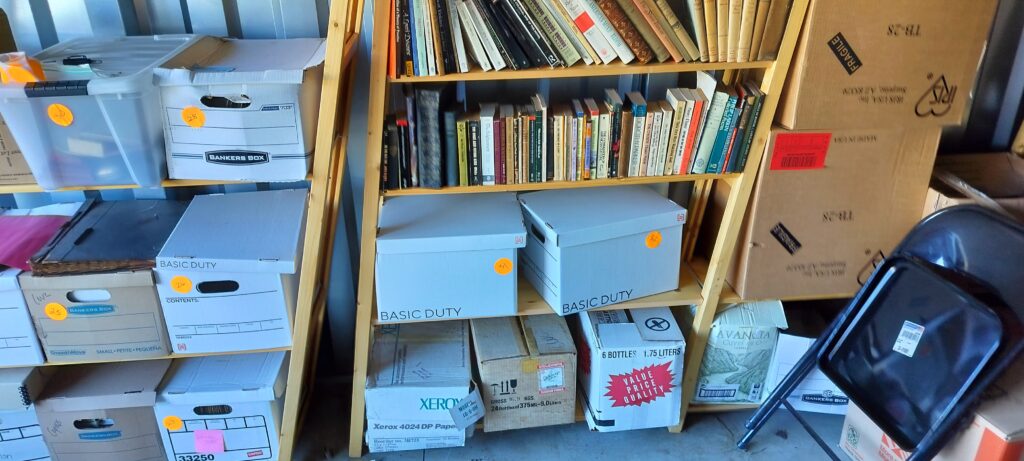
That’s okay! Often, you only discover what is missing when something forces you to look. So the work is partly knowing what you have, partly knowing where the gaps are, and partly being willing to keep filling them in.
Another sideways question
The Authors Guild and the Association of American Publishers have also recently released a study of library e-lending. The Guild says the study finds a “substitutive effect” on consumer sales. Put more plainly, and this is my translation rather than the Guild’s wording, the researchers find evidence that some library ebook loans replace purchases that otherwise might have happened.
The Guild is careful to say this is not an argument against libraries or digital lending, and acknowledges the important role libraries play in discovery and preservation. But it does use the findings to argue against efforts to require cheaper or less restrictive ebook licensing, particularly for high-demand titles.
As an author, a library advocate, and a literary steward, I’m interested in what the finding captures, but also in what happens when we change the time horizon. A newly published bestseller and a book that has been in print for sixty years are not necessarily doing the same thing in the marketplace. For a long-lived backlist title, library circulation might replace some purchases. It might also generate purchases, introduce new generations of readers, sustain classroom and community use, or help maintain the cultural presence that keeps a book commercially viable.
I’m working on a research project looking at that question over time, using A Wrinkle in Time as a case study and comparing library circulation with retail sales. I don’t know yet what the data will show, but I’ll share results here when ready.
If you’re new here
Tesser Well grew out of questions like these: how creative work is stewarded over time, what happens when rights, relationships, values, and markets pull in different directions, and how the decisions we make now shape what remains possible later.
You can explore more of the thinking in Stewardship in Practice, find practical material in Resources & Tools, or read about the consulting work.
And if you’d like occasional notes when there’s something worth sharing, stay in the loop.
About the Author: Charlotte Jones Voiklis